 By
By 
Children playing in Biloxi, Miss. Photo courtesy of WKKF
Nearly two decades after Hurricane Katrina, the people of New Orleans continue to be a testament to hope, ingenuity and perseverance. Communities have done more than rebuild — they are reimagining systems to create opportunity for all, especially children. While significant progress has been made, critical work remains to ensure that growth is truly equitable and lasting. As part of an ongoing reflection series called Rooted In Us, W.K. Kellogg Foundation (WKKF) staff and local leaders will share their perspectives on community efforts, lessons learned and the investments still needed to build a future where all New Orleanians can thrive. WKKF has been investing in New Orleans since the 1940s but named the city a priority place after Hurricane Katrina. As we look ahead, we remain committed to working alongside partners to strengthen economic opportunity, racial equity and community leadership for generations to come.
In this conversation, Alyson Curro, a communications officer for WKKF, sits down with Oleta Fitzgerald, director of the Children’s Defense Fund’s (CDF) Southern Regional Office, and Kim Robinson, program officer at the same office. Their conversation reflects on CDF’s post-Katrina response — from reuniting families and launching emergency Freedom Schools with mental health supports to convening the Katrina Citizens Leadership Corps to shape national policy. They recount how children and families endured displacement and trauma, how grassroots networks became lifelines and the lessons that continue to guide disaster response and child advocacy today.
Early days after Katrina
Curro: I’d like to ground us in those early days after Hurricane Katrina. For those who may not have lived through it, what stands out most about that immediate aftermath — either what you experienced personally or what you saw families and children facing?
Fitzgerald: The Children’s Defense Fund (CDF) Southern Regional Office had been working in Louisiana since we opened in 1995, so when Katrina hit, it shook us deeply. At first, like everyone, we were stunned watching the news — the chaos, the levees breaking. We also didn’t know where many of our people were.
A few days later, once our lights came back on, we gathered at the office to ask, “What can we do?” Families were being separated, children put on one bus, parents on another. We realized our first task was to help reconnect people. Because our office had power and internet, we started building lists, matching families, even before the Red Cross systems were in place. We went down to the Mississippi Coliseum in Jackson and tried to help — until eventually the Red Cross told us to step aside.
Robinson: I had lived through many hurricanes in Louisiana, but something about this one felt different. Before the storm even made landfall, I told Oleta, “This is bad.” My husband, who worked for Enterprise, was being sent inland with all the cars — that was a sign.
The storm hit all the way into central Mississippi, leaving most of us without power. I didn’t have electricity at home, but Oleta did. I’d go to family members’ houses to call her, and we’d sit watching TV — showing the devastation, the suffering — knowing people we loved were right in the middle of it.
One of our first priorities was locating our friend and ally Mary Joseph. We tracked her down in Georgia, safe, and immediately she wanted to get back to work in New Orleans. That was the spirit: even in devastation, people were ready to act.
Fitzgerald: That’s right. And the Kellogg Foundation, as always, gave us the flexibility to redirect existing grant funds to meet immediate needs. Families couldn’t get to ATMs, hotels were full and people had nothing. My daughter and son-in-law, both in real estate, helped us put displaced families into unsold homes with air mattresses and groceries. Mary would call, people would find us — it really felt like a way station on the Underground Railroad.
Defining the work
Fitzgerald: At first, the best infrastructure we could build was simply helping families reconnect. We partnered with radio and TV stations and pushed information via ticker tapes so people could find each other.
But very quickly we saw broader needs: Parents were traumatized yet trying not to show it in front of their children. Families were jammed into hotel rooms and relatives’ homes. One of the things that weighed on us heavily was that parents could not show their emotions to their children — this was the worst of circumstances, and they had to keep a stiff upper lip or their children would have just lost it. I remember saying, “We’ve got to get these children away from these parents. We have got to figure out a way to let parents grieve so they can start figuring out what they’re going to do next without having to worry about their children.”
That’s where we leaned into Freedom Schools. CDF had operated Freedom Schools for decades, so we brought in the national team to talk through how to get children out of those hotels and into safe, structured spaces for learning and healing. We connected with children-serving organizations — the Y, schools, community partners — across the city and region. That became our anchor response and the initial Katrina Freedom Schools project, which was eventually supported by the Kellogg Foundation. We operated sites across the diaspora: Texas, Georgia, Louisiana and Mississippi. Many families evacuated to Houston; a lot of the professional class went to Atlanta, including people from mental health and health systems — so we built around that core as part of our region’s response.
Robinson: At the same time, we realized families needed a voice in shaping recovery. That’s why we convened the Katrina Citizens Leadership Corps — about 250 people from across the diaspora. It became a brain trust: residents reflecting, documenting, making recommendations and raising up the voices of those most affected.
Fitzgerald: And alongside that, we worked with community partners to bring Kellogg Foundation trustees directly into the devastated areas — New Orleans, Biloxi, Jackson. We organized site visits and panel discussions with system leaders: housing, health, mental health, schools, infrastructure. Trustees walked through the Superdome, where makeshift medical units were still set up. They heard directly from doctors, families and service providers about what was happening on the ground.
Robinson: That exposure was critical. It wasn’t abstract anymore — they could see there wasn’t a single area of life untouched. And it influenced the decisions about where investments would go.
Fitzgerald: Exactly. Out of all that came our three clear areas of focus: Freedom Schools with integrated mental health supports for children, the Katrina Citizens Leadership Corps and resource-and-referral work.
Robinson: The Citizens Leadership Corps helped produce the “How to Build a Village” report, which documented families’ experiences and pushed FEMA to treat child care as essential infrastructure.
Fitzgerald: And that’s what changed. For the first time, child care was recognized as part of disaster response. Families can’t rebuild if children don’t have somewhere safe to be.
Systems change
Curro: You were responding so quickly in the middle of chaos. How were you able to get these programs off the ground with so little infrastructure?
Fitzgerald: Because we had networks already in place. We’d worked in these communities for years — in healthcare, early childhood, policy — and we knew who to call. In Houston, Atlanta, Jackson, we already had partners and infrastructure from Freedom Schools and advocacy work. When Katrina hit, those networks became lifelines.
We pulled in groups like the Mississippi Center for Justice, Carol Burnett’s organization, civil rights attorneys — people who were already trusted and effective. Everyone brought their expertise to the table. It was like a coalition of people who all said, “We will not let families fall through the cracks.”
Robinson: And we learned quickly that the work wasn’t just about services — it was about documenting and changing systems. Families without deeds to “heirs’ property” couldn’t rebuild. Families without access to medical records couldn’t get care. Kids without school records couldn’t re-enroll. By documenting those gaps, we pushed for reforms that still shape disaster response today.
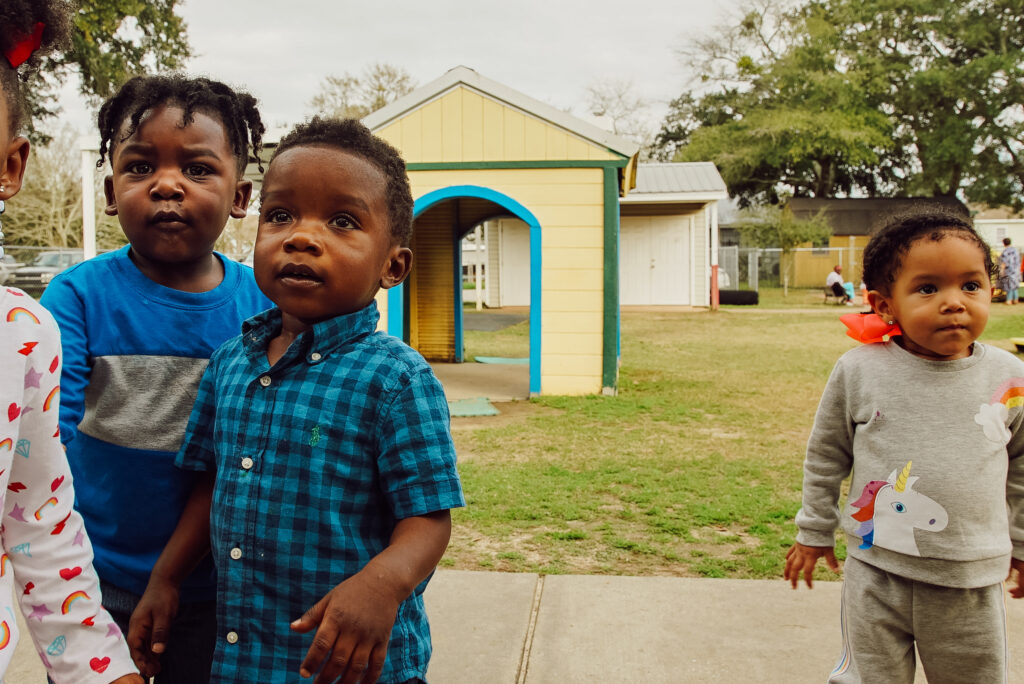
Children playing in Biloxi, Miss. Photo courtesy of WKKF
Shifts in the work
Curro: CDF has always centered on the needs of children, especially children living in poverty. How did Katrina shift your worldview and your work? What long-term strategies took root because of what you saw and learned during that time?
Fitzgerald: Marian Wright Edelman always valued Freedom Schools, but Katrina made them central to our response. We could see the difference they made for children living with poverty and trauma. Freedom Schools became a stronger national priority for CDF after that.
We had already been doing early childhood work through Supporting Partnerships to Assure Ready Kids (SPARK), but after Katrina we looked at it differently — through a policy lens. Systems had to change so that schools and agencies were ready to receive children, not turn them away. That’s where the money and the leverage were. Jackson Public Schools is still operating Freedom Schools, and some of their teachers are even trained in Freedom School pedagogy.
Marian also issued “Katrina’s Children Still Waiting.” That report put a face on the statistics — you could see the children, feel the poverty and understand the trauma of families who were too poor to evacuate. For me, it deepened my understanding of who we were serving and just how callous this country can be toward poor families.
Robinson: And those children are adults now, but many haven’t been fully healed. Mental health was a missing piece then, and it’s still a missing piece today. We tried to address it in Freedom Schools through art, music, spoken word and storytelling, but those supports didn’t continue once the programs ended.
The lack of empathy for families after Katrina was devastating. And it wasn’t unique. We saw the same thing during COVID: When America sees Black and Brown people hurting, it often looks the other way.
Fitzgerald: That’s why integrating mental health into Freedom Schools mattered so much. We recruited experts to work alongside our servant leader interns. Some of those interns completely changed their career paths because of what they experienced — many went into teaching. When Arne Duncan was Secretary of the U.S. Department of Education, Marian brought him down to New Orleans to meet with 20–30 young Black men who had shifted into education. They were living proof that investing in young people could build a new pipeline of educators who understood their communities.
Robinson: And it wasn’t just about teaching children. It was about conflict resolution, cultural belonging and preparing kids to navigate systems. When children were displaced to new communities, many felt unwelcome — teased for how they talked or treated like outsiders. Some went back to unsafe neighborhoods because they didn’t feel they belonged anywhere else. That’s how cycles of incarceration and violence continued. Freedom Schools gave us a model for breaking that cycle.
Progress and unfinished work
Curro: As we approach the 20th anniversary of Katrina, what stands out to you as some of the most meaningful progress in the region, and where is the work still unfinished?
Fitzgerald: In early childhood education, there’s been real progress. We used to talk about “child care” as little more than work support. Now we talk about early learning and brain development. There’s broader recognition that the earliest years matter for school readiness and lifelong success. But it’s still hard for providers to sustain — margins are thin, wages are low and too many families still don’t have access.
Healthcare has also improved. The Children’s Health Insurance Program, Medicaid and later the Affordable Care Act closed huge gaps. If every eligible child were enrolled, millions who once would have fallen through the cracks would now have care. But access is uneven, and it depends on who’s in office. We’ve seen NICUs close in places like the Delta, where families already had to drive hours for care. Progress is fragile unless it’s embedded in systems that can’t be dismantled so easily.
Robinson: And access isn’t just about children — families need care, too. That’s why Medicaid expansion in Louisiana mattered so much. It brought in mental health coverage and reduced the stigma of seeking therapy. Mississippi still hasn’t expanded, and that leaves 200,000 adults without coverage. So, while we’ve made progress, politics too often stands in the way.
Housing is another area. Our work with the Mississippi Center for Justice and other partners helped create strong public interest law programs around housing, heirs’ property and disaster recovery. That came directly out of the Katrina Citizens Leadership Corps. But too many families remain locked out because systems were never designed with them in mind.
Looking Ahead
Curro: As we close, what do you most want people — both local communities and national audiences — to take away as we reflect on Katrina 20 years later?
Robinson: Be curious. Learn what emergency systems exist in your own community. How will they respond when disaster strikes? If they don’t meet people’s needs, organize to change them. Because floods, fires, hurricanes — they’re happening everywhere now. Preparation and accountability are key.
Fitzgerald: And remember this: Sometimes families are so poor they can’t escape danger. That’s true literally, like during Katrina, but also metaphorically — when wages are too low, when healthcare is out of reach, when education systems fail to support children. People have capacity, but they need support.
We have to stop punishing poor people for being poor. If we build education, healthcare and workforce systems that actually work for them, we all benefit. Every child deserves the chance to thrive. That was true during Katrina, and it’s true today.
Want to learn more about the Children’s Defense Fund and how they’re working to tackle systemic inequities affecting children and youth across the country? Visit childrensdefense.org to explore their programs, learn about the impact of their advocacy and discover ways you can contribute or get involved.
Comments